Every agency owner knows the rule. Good, fast, cheap: pick two. I've said it across a lot of conference tables. Good and fast won't be cheap. Fast and cheap won't be good. Good and cheap will take a while.
For most of my career, that rule was simply true. I don't say it anymore. You can have all three now, on one condition, and the condition is the part worth talking about.
The rule was always about hours
Nobody ever wrote down why the triangle worked. It wasn't a law of nature. It was arithmetic.
Good work took skilled hours. Skilled hours cost money and they came one at a time. So if you wanted it better, you paid for more of them. If you wanted it sooner, you paid for people to work nights or you took something off the list. Every project I scoped in twenty years was some version of that negotiation, and over hundreds of projects I got pretty good at having it.
AI changed the arithmetic. A lot of the hours in a project were never the valuable part. They were the typing, the first drafts, the repetitive checks and the looking things up. I once built a working tool to pull image metadata out of an archive of thousands of photos in under two hours, which I wrote about in I'm not an AI guy. By hand, that job would have taken more hours than any budget could justify.
What it looks like on a real project
At nimblefish, the web studio I run, a client's note can come in the morning and be live that afternoon. It used to sit in a queue. The change itself was never hard; the hours around it were the slow part.
The bigger shift is in scope. The things that used to get cut to fit a budget stay in. The common questions on every page, written so people and AI answers can both use them. The careful accessibility review. The redirect for every old address. The second and third design options. Those were always the right things to do. Now there's room to do them.
That's what "all three" means in practice. It costs less to produce, it arrives sooner, and more of what you wanted is in it.
Here's the condition
AI will happily give you fast and cheap by itself, in about nine seconds. It takes a person to get to good.
The model doesn't know that your client hates the word "solutions." It doesn't know that the sentence it wrote is legally shaky, or that the nice layout falls apart for someone using a screen reader, or that the third request on the list is the one that actually matters. It produces something that looks finished. Looking finished was always the hard part for a person, and it's the easy part for a machine, so the old signals of quality don't tell you much anymore.
Without someone in the room who knows what good looks like, you don't get all three. You get two, and a convincing imitation of the third.
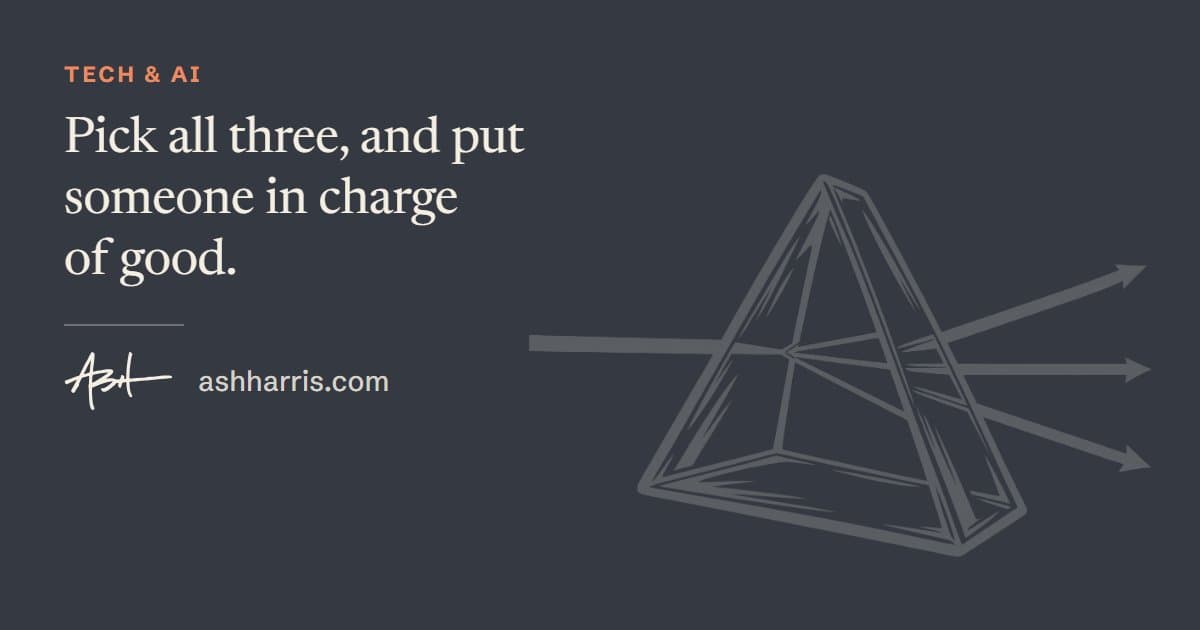
So here's the new rule: good, fast, cheap, pick all three, and put someone in charge of good. That person's judgment is the one thing in the triangle that didn't get cheaper. If anything, it's worth more now, because it's the part that's left.
What this means when you're the one buying
If you hire people to do work for you, this should change how you buy.
Ask for more. If something got cut to "phase two" because of the budget, ask again. It may fit now. A good partner will tell you honestly what's changed in how they work.
Ask who checks the work. Not whether they use AI. Most people do, or will. Ask who reads it before you see it, and what they look for. You want a specific answer with a person's name in it.
Pay for the judgment. "Cheap" in this conversation means what the work costs to make, which isn't the same as a bargain. Lower production cost should mostly show up as more scope and faster turns. The experience directing that work is what you're buying, and it's worth paying for properly.
And give it some thought before you adopt any of this yourself. A new tool still has to earn its place in your business. Start with one thing that's slow today and see what happens to it.
One more thing about that old sign
I have some affection for the triangle. It taught a generation of us to have honest conversations about tradeoffs, and tradeoffs haven't gone anywhere. They've moved. The hard choices used to be about what you could afford to build. Now they're about what's worth building, which is a far better conversation to be having, and the one I've always liked best: standing at the whiteboard, working out what actually matters.
If you've got a project that got trimmed to fit a budget a few years ago, pull it back out. I'd be curious what it looks like now.