
Most people with a long idea list think their problem is time. Some think it's discipline. Usually it's neither. The list was built to catch ideas, and nobody ever built the part that moves one out.
A list like that fills up beautifully. It also feels like progress every time you add to it, because adding to it is the same motion as making progress. That's why it can go on for years.
Look at the columns
Open whatever you keep: the idea file, the swipe file, the "someday" folder, the CRM full of people you meant to call back. Look at the columns.
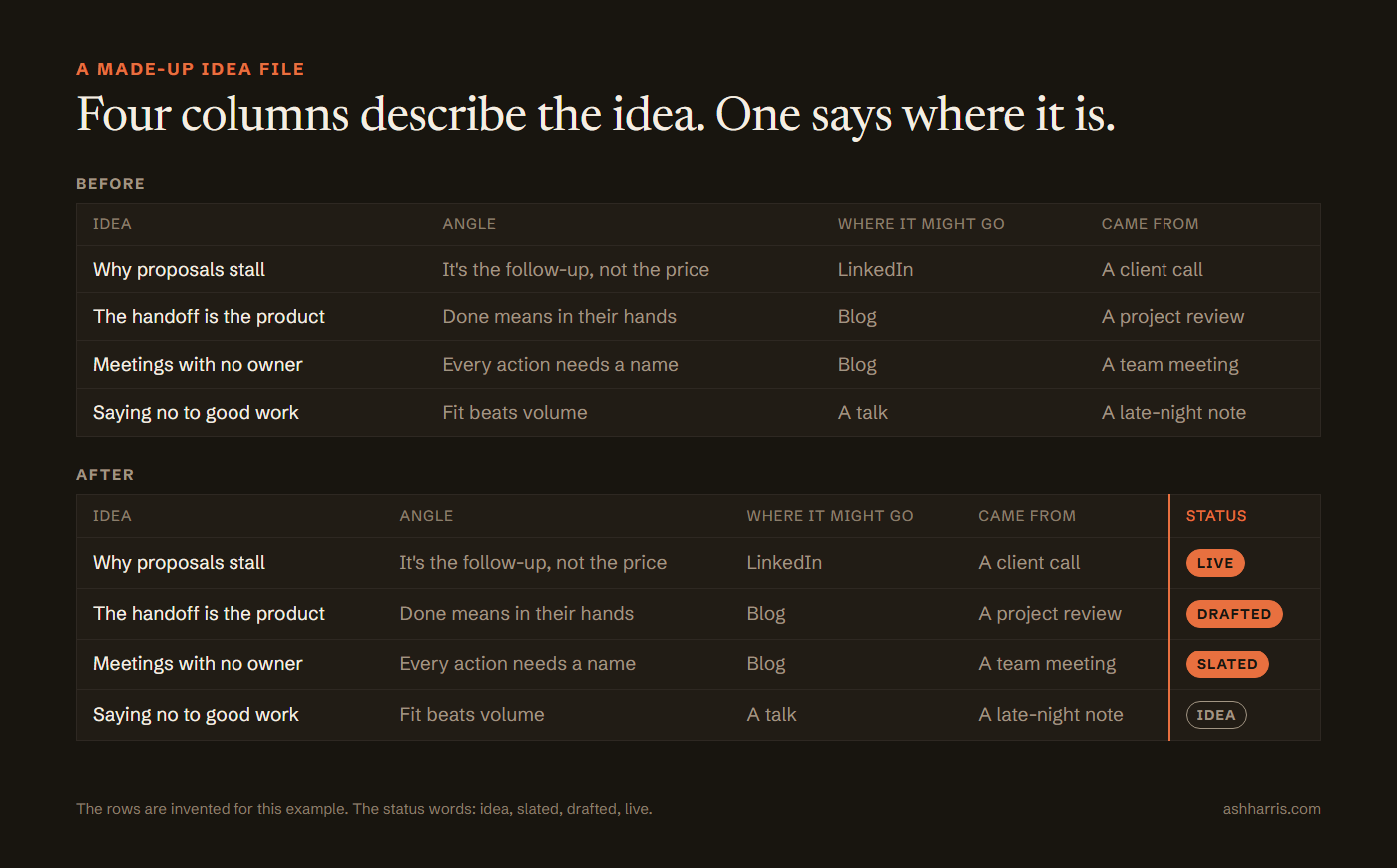
Most of them have some version of the same four: the idea, a note on the angle, where it might go, and where it came from. Every one of those columns describes the idea. Not one of them says where it is.
There's no ready. No drafted. No scheduled, no done. So the hundredth good idea sits in exactly the same place as the first one, and from the inside, a file with a hundred ideas and no status feels a lot like having no ideas at all.
 (opens a larger, zoomable view)
Catching and shipping are two different jobs
Capturing an idea is one job. Moving it to finished is another. They need different tools, and most of us only ever build the first one, because it's the fun one. A great idea at 10 p.m. gets written down. Nobody gets excited about a column that says drafted.
But the second job is the one that pays. A business doesn't run on what it meant to do.
What fixed it for me
I keep a long idea file for my own writing, and for a while it had the same four columns everyone's does. What changed it wasn't more discipline. It was three plain things:
- A status on every idea. Idea, slated, drafted, live. Four words. Now the file tells me where everything is, not just what it is.
- A short list that comes first. A handful of pieces picked for the next few weeks, out of the hundreds. The rest can wait. That's what a backlog is for.
- A date a week ahead. What goes out next Wednesday gets decided this Wednesday. Picking on the morning it's due is how the slot goes empty.
None of that is clever. It's plumbing. And it's the difference between a file that grows and a calendar that fills.
It isn't only content
The same thing happens anywhere a list catches more than it moves.
The sales pipeline full of "warm leads" nobody has called in six months. The project board where every card says in progress. The improvement ideas from the last team meeting, written on a whiteboard, photographed, and never opened again. Each one looks busy and feels productive, and the thing it was supposed to feed stays hungry.
The tell is always the same: the list keeps getting longer while the thing it serves gets thinner.
Leaders own the second job
If you run a team, the capture part usually takes care of itself. People are full of ideas. What they need from you is the second job: a clear sense of what's next, who has it, and when it's due. Someone has to decide what comes off the list and what waits, and say it out loud.
Finishing is a decision, not a mood. I've written about why the handoff is the product: the work isn't done when it's good, it's done when it's in someone's hands. An idea is the same. It doesn't count until it ships.
Start with one column
Tonight or tomorrow, open the list you're proudest of. Add one column. Call it status. Fill it in honestly, then pick three things and give each a date.
You'll probably find, the way I did, that the ideas were never the problem. They were waiting for somewhere to go.