Experience is the reason you're good at what you do. It's also the reason some of your answers stopped being checked a long time ago.
That's not a flaw. It's how expertise works. You solve a problem well enough times and the solution moves from a decision to a reflex. Reflexes are fast, and fast is valuable. The catch is that a reflex never asks whether the world it was built for is still there.
The answers that used to be right
Nobody holds on to bad ideas for long. The bad ones get caught. What lasts is the good idea whose time passed quietly: the method that worked for ten years, the tool everyone used, the rule you taught your whole team.
Those are the hardest to let go of, because the evidence is on their side. You have years of proof they worked. What you don't have is proof they still do, because nobody's been looking.
Three I let go of
I've been building websites for more than twenty years, thirteen of them running an accessibility consultancy that served global banks, auto manufacturers and universities coast to coast. That's a lot of reflexes. A few of them I've had to put down on purpose.
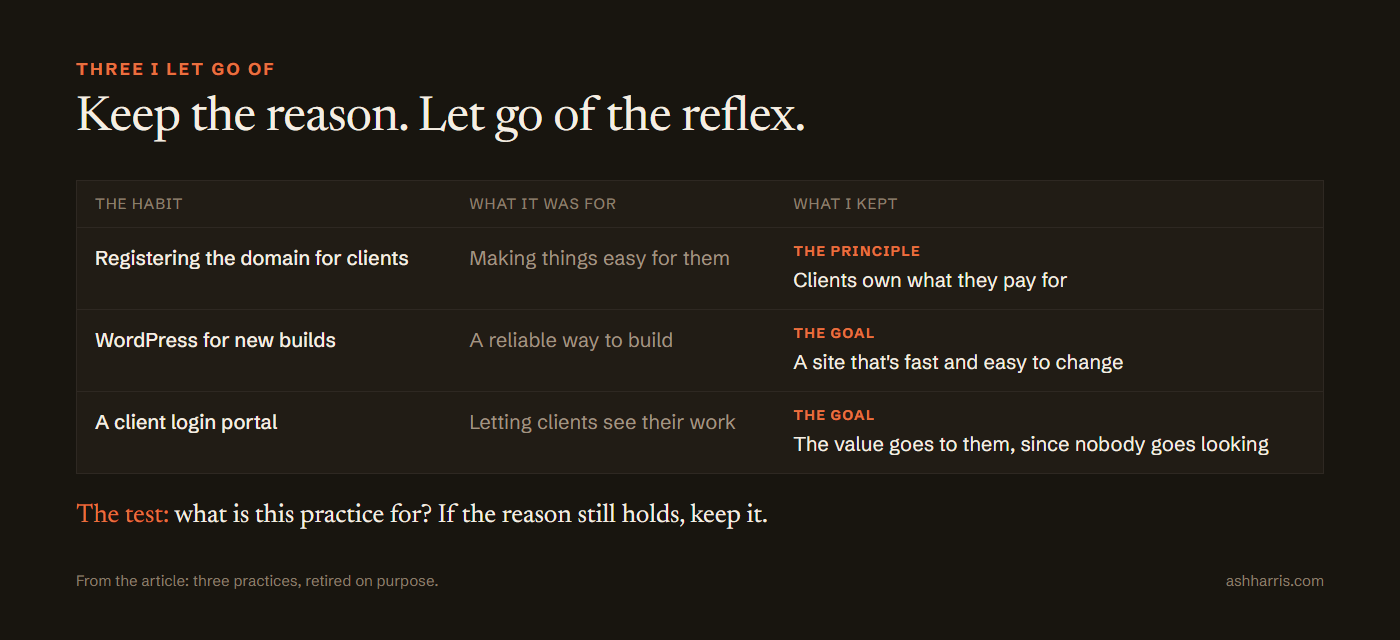
- WordPress for new builds. I built on it for twenty years. It was the right answer for most of that time, and I knew it inside out. Today I wouldn't start a new website on it, and I've said so plainly. Knowing it well is exactly why I can see where it no longer fits.
- Holding the keys for clients. Years ago it was normal for the web person to register the domain and keep the accounts. It felt like service. I stopped, because clients need to own their own infrastructure. No handcuffs.
- The client portal. The industry answer to "how do clients see their stuff" was a login. I built toward one, then watched how people actually behave: nobody goes looking. So the value goes to them instead.
None of those was a mistake when I started doing it. Each one became the wrong answer slowly, while still feeling right.
 (opens a larger, zoomable view)
How to tell a habit from a principle
Not everything old should go. Some of what experience gives you is a principle, and principles travel. "Clients own what they pay for" was true in 1999 and it's true now. "Register the domain for them" was just one way of doing business that stopped serving the principle.
So the test I use is simple: what is this practice for? If I can name the reason, and the reason still holds, keep it. If the reason has changed, or I can't name it at all, it's a habit, and it's up for review.
Where to look
Unlearning doesn't start with a big rethink. It starts with noticing.
- The sentence that starts with "we've always." Say it out loud and finish it with because. If the because is gone, so is the practice.
- The question a new hire asks. "Why do we do it this way?" is the cheapest outside review you'll ever get. Answer it honestly instead of quickly.
- The work you'd do differently if you were starting today. If you'd never set it up this way now, ask why you're still keeping it up.
- The tool everyone you trust has quietly stopped using. Usually the last to know is the person who knows it best.
It's harder for leaders, and more important
When you lead a team, your reflexes become their rules. They learned the way you do it, and they'll keep doing it that way long after you've changed your mind, unless you tell them you've changed it.
So say it out loud. "I used to think this. Here's what changed." That one sentence gives everyone else permission to update too. It's also one of the most credible things a leader can say, because it shows the experience is still working, not just stored.
Experience that keeps moving
The goal isn't to know less. Twenty-plus years of doing this work is the reason I can spot the old answers at all. The goal is to keep the experience moving: hold on to the reasons, let go of the reflexes, and check the difference every so often.
The best people I've worked with are rarely the ones who were right the longest. They're the ones who noticed first when they'd stopped being right.