
When you run more than one thing, the plan that holds them together has to start with you, not with any one of them. Write one plan for the person, then a plan for each business underneath it, and decide on purpose how they help each other.
That sounds obvious written down. It took me a while to say it out loud.
Three businesses, three plans, one person
I run nimblefish, my web studio. I'm Chief Global Growth Officer at esther.ai. And there's ashharris.com, which is where people find me, my writing and my speaking. Each is real work with its own audience and its own goals.
So I did what everyone does. I sat down to write a growth plan for each one. Three sets of goals, three calendars, three lists of what to do next. Every one of them was reasonable. Together, they all wanted the same Tuesday.
The question that sorted it out
The question that untangled it wasn't about any of the businesses. It was: who is all of this for?
The answer was me. Not in a selfish way. In the plain sense that each of these businesses exists because of what I want my working life to be: the people I get to work with, the problems I get to solve, the presence I want to have in my community and in my field. They run on their own as businesses. But they serve one person's growth.
Once I said that, the planning got simple.
One plan on top
The top plan is mine. It holds the few things that matter across everything I do: where I want to be at the start of next year, how I want to spend my weeks, what I'm building toward. It's short. It changes slowly.
Under it, each business has its own plan, with its own goals and numbers. Those can be as detailed as they need to be, because they no longer have to compete with each other for what matters most. That question is already answered one level up.
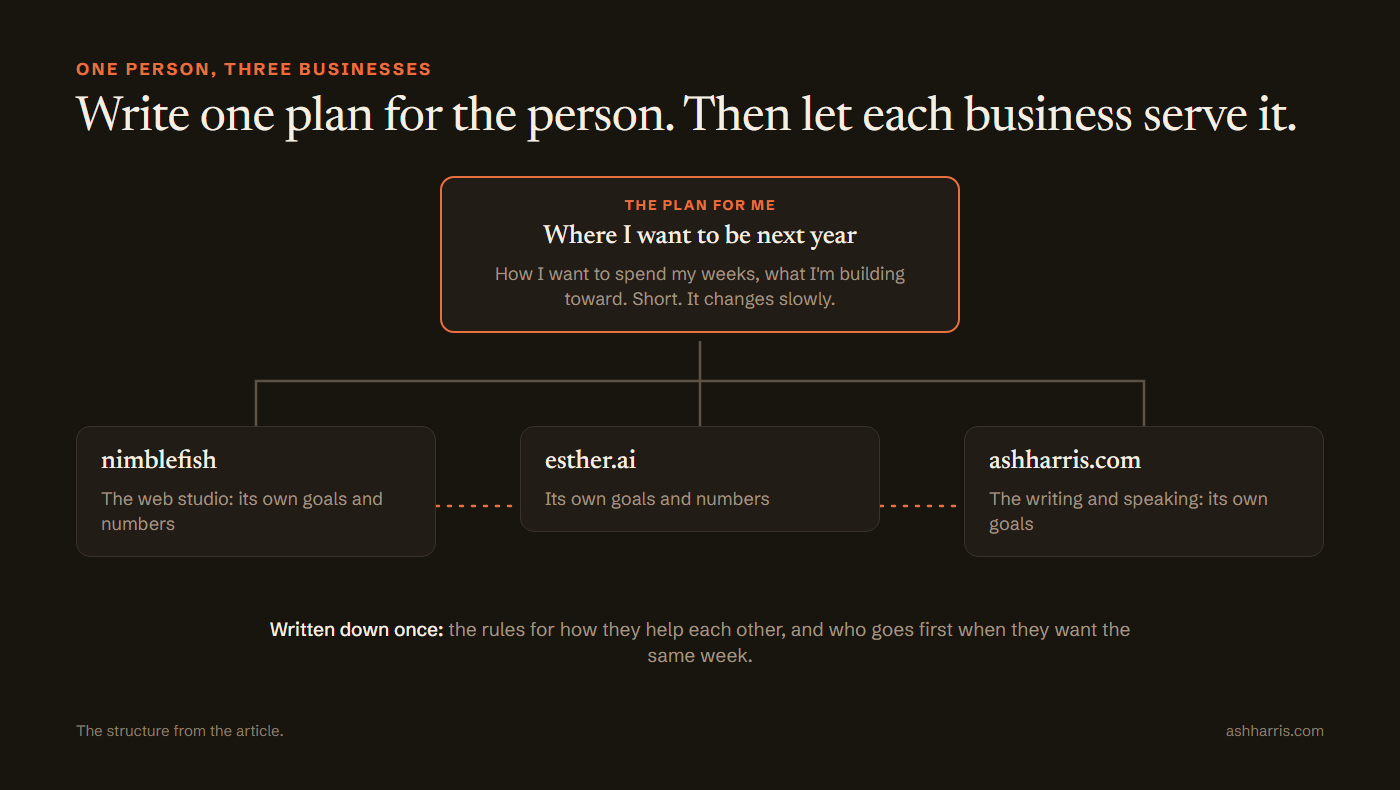 (opens a larger, zoomable view)
Decide how they help each other
Then the part I'd missed before: rules for when the businesses work together.
When does a piece I write for one belong on another? When does one refer to the other, and when should it stay out of the way? Who goes first when they both want the same week? Written down once, those questions stop coming up every Monday.
It turns out the businesses help each other more when they each know their job. That's the opposite of what I expected.
It's a leadership question, too
You don't need three businesses for this to apply. A leader with a team, a board seat and a family is running several plans already. So is a founder with a company and a podcast.
When everything feels urgent, ask who it's all for. If the answer is a person (you, your family, the life you're building), then that person gets a plan first. Everything else serves it.
Start with a page
Write one page about you: what you want the next year to look like, in your own words. Not a business plan. Your plan. Then look at each thing you run and ask how it serves that page.
I wrote about the bigger version of this in Know thyself. This is the practical end of it. Know what you're for, and the plans line up behind it.